_
Paddi is an AI product manager agent that reads your codebase, diagnoses the root cause behind every request, and generates specs your code agent can ship.
Confident
Every decision backed by real code and real data.
Clear
Every conclusion traceable to its source.
Autonomous
The agent works. You review and decide.
End-to-end
From feedback to PR in one workflow.
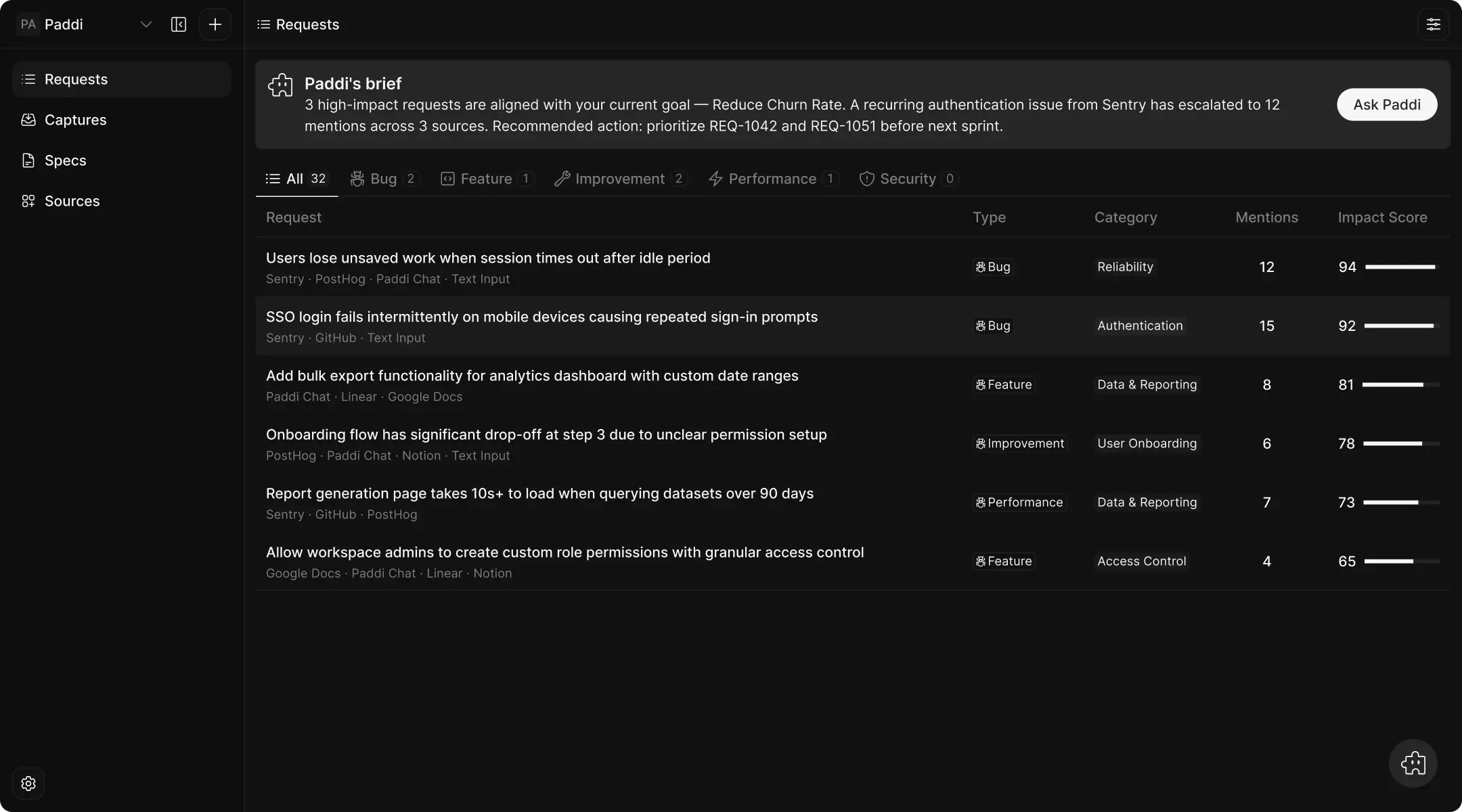
Before your code agent builds, Paddi thinks.
Code Agents make development lightning-fast, but pre-coding remains fragmented: manually piecing together data for AI, identifying core user needs, and the constant back-and-forth between tech and business. When coding is no longer the bottleneck, fast and correct product decisions become the ultimate challenge.
Paddi bridges the gap between raw signal and execution-ready blueprints.
Root-Cause Analysis, not guesswork.
When raw signals flow in, Paddi automatically cross-references historical feedback and error logs, analyzing them against your codebase and external data sources to surface the real core behind every request.


Goal-Driven Priority Scoring
Define your business objectives and prioritization logic. Every request gets ranked by impact, alignment, and cost. Priorities update the moment your goals change.
Solution Options with Clear Trade-offs
Multiple paths, each laid out with impact scope and estimated effort. You make the call on what gets built.

AI-Generated Specs, Human-Refined
Full spec with edge cases generated in seconds. A built-in WYSIWYG editor lets you refine every detail side by side with Paddi.


Flexible Delivery, One Click Away
One click to launch a code agent, share a link, or create a task. However your team works, the spec is ready to go.
It finds the evidence before you look
Most AI tools generate plausible specs. Plausible isn't the same as buildable.Paddi works the other way around: it pulls from your codebase and data sources first, then reasons. Every conclusion arrives with the evidence already attached.

Grounded in your codebase
Paddi indexes your repository's structure, dependencies, and search graphs to know which modules are involved and where friction lives.
Investigates before it concludes
Paddi connects to your analytics, session data, error logs, and historical requests. The context is there before you need it.
Don't trust the AI. Trace it.
Every conclusion links back to the feedback it came from, the code it read, and the logic it followed.
Paddi's reasoning trace
Paddi identified a converging signal across three sources: team invite success rate has dropped to 61% over the past 3 weeks.
Invite send success rate 61%, declining for 3 consecutive weeks
"Invited my teammate but they said they never got it" · "Tried multiple times, kept failing"
"We want the whole team on board but the invite keeps breaking"
Paddi traced the failure to a silent timeout in the email send service. The invite route has a 3s timeout with no retry — any network hiccup causes a silent failure with no feedback to the user.
Scored against your active business goal: grow expansion revenue through team account growth. Invite failures directly block the team expansion path — 214 users hit this failure in the last 30 days.
8.9/10
9.7/10
2.4/10
85/100
Add retry logic (max 3 attempts) with silent fallback. Touches 1 file, ships today. Users still won't see send status — treats the symptom, not the cause.
Retry logic + UI error feedback — inviter sees clear failure message. Touches 2 files, estimated half a day. Meaningful UX improvement with low risk.
Retry logic + real-time status tracking + auto-notify inviter on failure + send log. Touches 4 files, estimated 2 days. Eliminates the problem entirely and creates an audit trail.
PM selected Option C. Paddi generated the full spec with edge case coverage — including expired invite links and duplicate email invites — and dispatched to Code Agent.
Built for the long run
Context that remembers
Your codebase, past requests, and business priorities live inside the same analysis loop. The tenth request knows what the first nine taught it.
Knowledge that survives the team
People leave, priorities shift. Every past analysis, decision, and context lives in Paddi, so the next person picks up where the last one left off.
Always improving underneath
Paddi's analysis engine, context strategies, and integrations update continuously so yours don't have to. Your engineering hours belong to your product.
Built for builders who build
Solo builders wearing every hat
You're the PM, the developer, and the one fielding customer calls. Every interruption resets your thinking. Paddi keeps it alive so you resume from insight, not scratch.
Small teams, no dedicated PM
No one owns product management. Priorities run on gut feel and get realigned every meeting. Paddi brings decision structure without adding headcount.
Teams shipping with code agents
Your code agent builds fast. But gathering context and writing the spec still falls on you. Paddi handles the thinking between feedback and PR.
Connects to your stack


